Subsection 12.6.1 The Differential Capacitors Inside the Sensor
A MEMS (Micro-Electro-Mechanical Systems) accelerometer measures its proof mass’s displacement capacitively, and the real structure uses two capacitors per sense direction, not one. The moving plate, attached to the proof mass, hangs between two fixed plates: it forms a capacitor \(C_1\) with one and a capacitor \(C_2\) with the other. At rest the two gaps are equal, so \(C_1 = C_2\text{.}\) When the case accelerates and the mass gets left behind, one gap narrows and the other widens, so \(C_1\) grows as \(C_2\) shrinks.
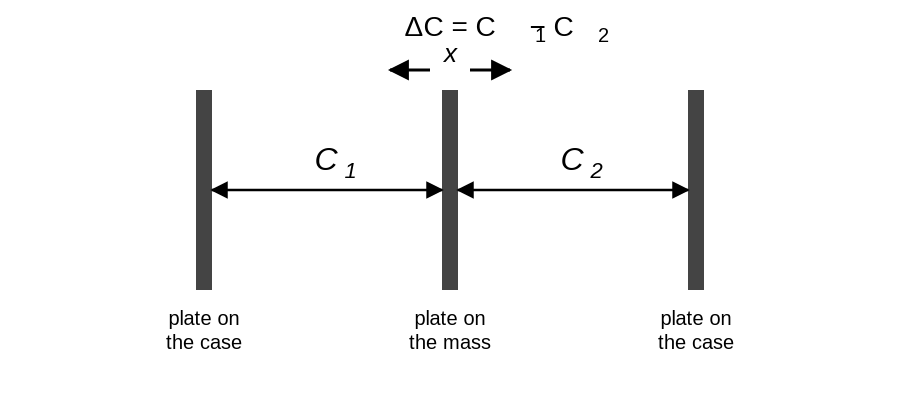
The electronics measure the difference, \(\Delta C = C_1 - C_2\text{,}\) which is zero at rest, grows with displacement, and carries the direction in its sign. With a known excitation voltage \(V_{exc}\) across the plates, \(Q = CV\) turns the capacitance difference into a charge difference, \(\Delta Q = (C_1 - C_2)\,V_{exc}\text{,}\) which the chip’s amplifier converts to a voltage for the ADC (analog-to-digital converter). Measuring the difference of a matched pair, rather than one capacitance alone, cancels effects that move both capacitors together, such as temperature.

