Subsection 5.1.2 BJTs: Current-Controlled Switches
A Bipolar Junction Transistor (BJT) has three terminals: base (B), collector (C), and emitter (E). In an NPN BJT, the type most commonly used to switch loads to ground, a small current flowing into the base allows a much larger current to flow from collector to emitter. The ratio of collector current to base current is called \(h_{FE}\) (or \(\beta\)) and is typically 50–300 depending on the device.
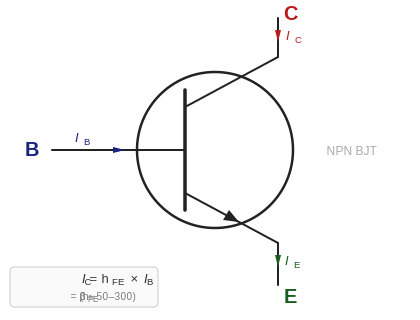
The base-emitter junction is a diode, so base current only begins to flow once \(V_{BE}\) is large enough, which for silicon is about 0.7 V. To use an NPN BJT as a switch from a GPIO pin, a resistor is placed between the GPIO pin and the base. This limits the base current to a safe value while still providing enough drive to saturate the transistor (push it into full conduction) so that the collector-to-emitter voltage drops to nearly zero and nearly all of the supply voltage appears across the load. We’ll work through how to choose that base resistor in class today, and you will do it again in Lab 3.

