Subsection 5.1.3 MOSFETs: Voltage-Controlled Switches
A Metal-Oxide-Semiconductor Field-Effect Transistor (MOSFET) has three terminals: gate (G), drain (D), and source (S). Unlike a BJT, a MOSFET is controlled by voltage, not current. The gate is electrically insulated from the rest of the device by a thin oxide layer, so in steady state it draws essentially no current from the GPIO pin. When the gate-to-source voltage exceeds a threshold (\(V_{th}\)), a channel opens between drain and source and current flows.
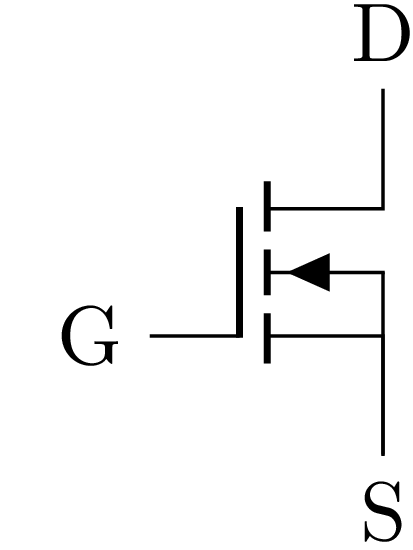
For embedded use the key requirement is that \(V_{th}\) be low enough to be driven reliably by a 3.3 V GPIO pin. Standard MOSFETs may require 5–10 V to turn on fully; logic-level MOSFETs are specified to reach full conduction at \(V_{GS} = 3.3\text{ V}\) or lower, making them directly compatible with modern microcontrollers. Because the gate draws no steady-state current, MOSFETs are often preferred over BJTs when the GPIO drive current budget is tight.

